Moles, also known as melanocytic nevi, are common skin growths that are usually harmless. However, a mole may be removed if it is bothersome, repeatedly irritated, cosmetically unwanted, or requires further examination because of suspicious changes.
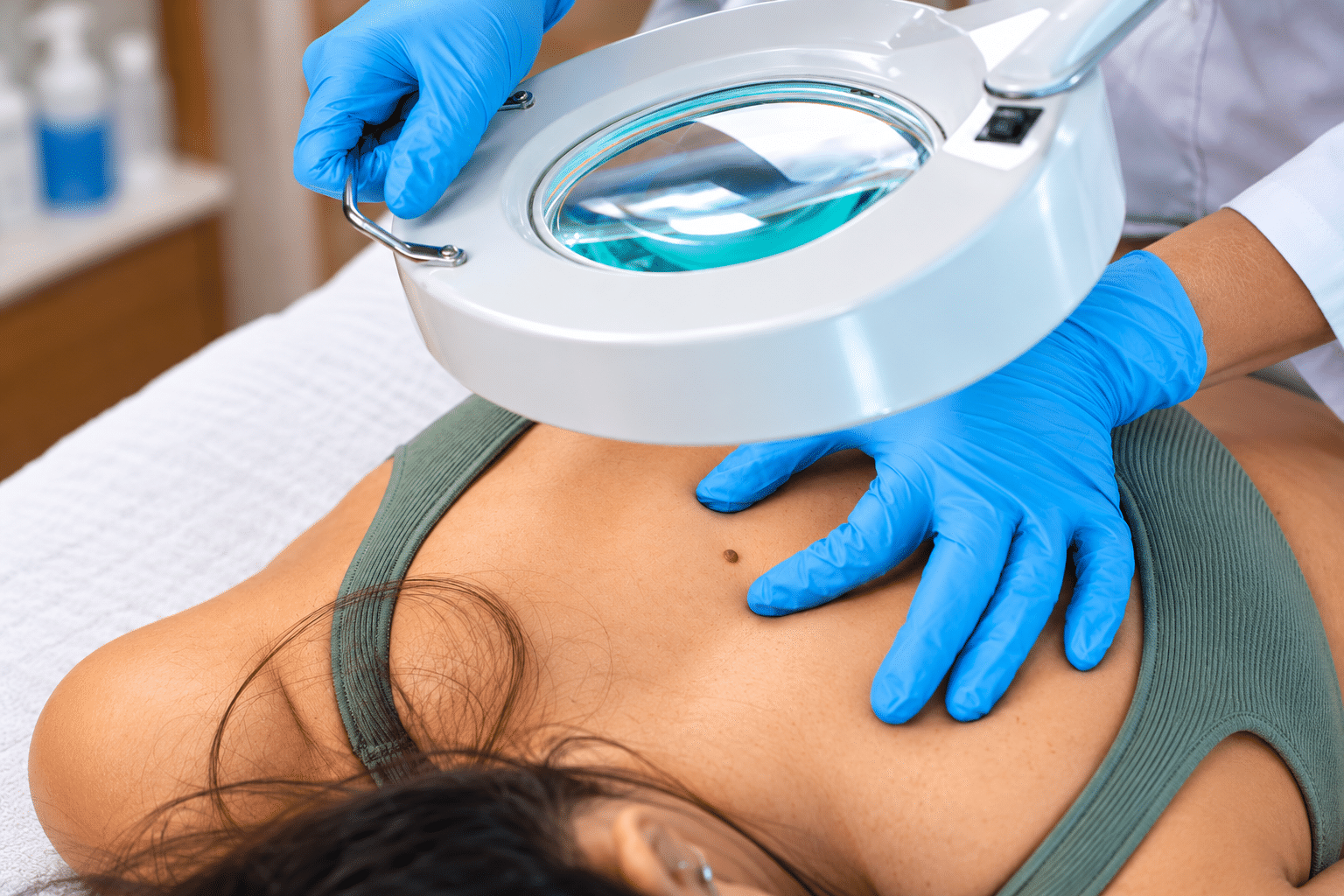
At Pure Derma, mole removal begins with a dermatological assessment to determine what type of mole it is and which removal technique is appropriate. When a mole needs evaluation for possible abnormal changes, the removed tissue may be sent for histopathological examination.
Mole removal may be considered when a mole:
A changing or suspicious mole should always be assessed by a dermatologist before cosmetic removal.
The removal technique depends on the mole’s appearance, size, depth, location and clinical assessment.
The entire mole is removed with a small amount of surrounding skin when appropriate, and the area may be closed with stitches. This method is commonly used when complete removal or laboratory examination is required.
A raised or suitable superficial mole may be removed using a surgical blade at the level of the skin. Whether this technique is appropriate depends on the individual lesion.
At Pure Derma, mole removal begins with assessment, not simply removal.
Your dermatologist evaluates the mole before deciding whether it should be removed and which technique is appropriate. When there is any concern about an unusual or changing lesion, diagnostic evaluation takes priority over cosmetic treatment.
The goal is careful removal with appropriate medical assessment and attention to the appearance of the treated area.
No surgical removal can guarantee a completely scar-free result. The appearance of the final scar depends on factors including the procedure, location, wound healing and individual skin characteristics.
No. Most moles are harmless and do not require treatment. Removal may be considered for cosmetic reasons, irritation or when a mole needs further evaluation.
Yes. A dermatologist can assess a mole and, if appropriate, remove it for cosmetic reasons.
A mole that is changing in size, shape or colour, or one that becomes itchy, crusted or bleeds, should be assessed by a dermatologist.
Dermoscopy is a non-invasive examination technique that allows a dermatologist to view structures within a skin lesion that may not be visible to the naked eye. It can help assess whether a mole has features that require further investigation.
The area is usually numbed with local anaesthesia before removal. You may feel some pressure or pulling during the procedure, but significant pain is generally minimised.
It depends on the removal technique and the size and depth of the mole. Surgical excision may require stitches, while some superficial shave removals do not.
Any procedure that cuts or removes skin can leave a scar. Your dermatologist can select an appropriate technique and provide wound-care advice to support optimal healing, but a completely scar-free result cannot be guaranteed.
Many mole removals can be performed during an outpatient consultation. The exact time depends on the mole, its location and the technique required.
Yes. When clinically indicated, the removed tissue can be sent for histopathological examination to look for abnormal or cancerous cells.
A mole can sometimes recur, depending on the type and removal technique. If a previously removed mole appears to return or changes, it should be reassessed by a dermatologist.
No. Cutting, shaving or applying unapproved products to a mole can cause infection, scarring and potentially delay the diagnosis of skin cancer.
No. Laser treatment is not appropriate for every pigmented lesion, particularly when there is concern about melanoma because tissue may need to be preserved for diagnosis. The removal technique should be determined after dermatological assessment.
Recovery depends on the technique, size and location of the mole. Your dermatologist will provide specific wound-care and activity instructions.
A suspicious mole should first be medically assessed. When melanoma or another concerning condition is suspected, appropriate biopsy or excision and histopathological examination take priority.
Your dermatologist will consider the mole’s size, shape, depth, location and appearance, along with whether it requires histopathological examination, before recommending the appropriate technique.
At Pure Derma, mole removal combines dermatological assessment with precise, personalised treatment.
Botox is a medical aesthetic treatment. Treatment suitability, dosage, injection sites, results and duration vary from person to person and will be determined after a dermatologist’s consultation.
Disclaimer: Mole removal is a medical procedure and may involve risks including bleeding, infection, scarring, recurrence or changes in pigmentation. Any changing or suspicious mole should be medically assessed before cosmetic removal.
